Menu
Section: Antisemitism

Modern antisemitism

This image is a antisemitic cartoon of the Rothschild family. The Rothschilds were a famous Jewish banking family. The financial success of the five Rothschild brothers who set up banks across Europe fed many conspiracy theories. Their critics often claimed they financially and politically controlled Europe. This added to the negative stereotype of Jews.

Courtesy of the United States Holocaust Memorial Museum.

The modern age brought new ideas and inventions.

This period saw the emancipation of the Jews in Europe, whereby many Jews gained equal rights for the first time. This allowed Jews to excel in new professions, and live in new places.

However, whilst legally the situation for Jews had changed, many of the antisemitic actions and attitudes they so often experienced continued.

By the end of the nineteenth century, an increase in antisemitic attitudes was evident in France and Germany. In Russia and Romania, antisemitic pogroms led to Jews emigrating westwards, to countries such as America and Britain. This section charts the development of antisemitism in the modern era.

The Enlightenment

Also known as the ‘Age of Reform’, the Enlightenment was a movement which started in the late seventeenth century and ended in the early nineteenth century. The movement saw the rise of ideas such as individualism, tolerance, freedom and scientific reason.

France is seen as the birthplace of the Enlightenment. After the French Revolution of 1789, France became the first country to emancipate the Jews and give them equal citizenship. This was followed by Belgium in 1830, England in 1858 and Germany in 1871.

Jews entered into new professions, could live where they pleased, and wear what they wanted to.

However, although legally the Jewish situation improved, antisemitic attitudes were still present. As such, when Jews started to expand into new professions and areas, they were often met with hostility.

Most people still saw Jews as outsiders, and development of ideas of ‘race’, as well as the rise of nationalism, increased this feeling.

Development of race ideas

Darwin’s On the Origin of Species by Means of Natural Selection was first published in 1858. His theory of evolutionary biology became the foundation of our understanding of life sciences.

Courtesy of The Wiener Holocaust Library Collections.

In 1859 Charles Darwin published On the Origin of Species by Means of Natural Selection. This book set out his theory of evolutionary biology. This has become the basis for life sciences today.

Darwin’s main idea was that organisms develop over time. Those that are able to adapt to their surroundings are the most likely to reproduce and therefore survive. Darwin’s theory is often described as ‘survival of the fittest’.

Social Darwinists misapplied Darwin’s theory of natural selection to socially constructed human groups. They believed that, just as the strongest plants and animals adapt to a changing world, the same applied to humans. Social Darwinists used this theory to suggest that some humans were superior to others.

Social Darwinism proved to be extremely dangerous. In time, Hitler would use their theory as a pseudo-scientific justification that non-Aryan’s were inferior races, and should therefore be exterminated.

The development of nations

The development of new and more democratic nations led to a growth in nationalism.

Nationalism is the idea that a community who share a language, culture, values, and history should come together to declare and promote their unity and individuality .

Although nationalism promotes unity, it may also oppose anything that threatens this unity, or anyone who is seen as not part of the larger community. One group of people who had continually been viewed as separate to the larger community were Jews.

The rise in nationalism then, alongside new ideas such as social Darwinism, intensified this distinction between Jews and other citizens.

The Dreyfus Affair

The Dreyfus Affair was widely discussed in the media. This image is a political cartoon from a poster, showing Arthur Ranc as a crocodile. Ranc was an outspoken defender of Dreyfus throughout his trial.

Courtesy of The Wiener Holocaust Library Collections.

The Dreyfus Affair was a political scandal which took place between 1894 and 1906. The Affair is an example of the growing antisemitism across Europe in the modern period.

In 1894, a document offering military secrets to the Germans was found in a bin and sent to the French Secret Service. This document was known as the ‘Bordereau’.

The investigation focused around Alfred Dreyfus, an officer in the French artillery who was of Jewish descent. Dreyfus was a suspect for three reasons:

  1. He was in the artillery (which was what the secrets had been about)
  2. He was an officer (so he would have access to this information)
  3. He was a Jew

Despite a lack of evidence, Dreyfus was arrested in October 1894 and found guilty in December of the same year.

Whilst his family claimed his innocence throughout, Dreyfus’ situation only changed when Georges Picquart was appointed as Head of the Information Service in 1895. Picquart soon discovered that Commandant Esterhazy was the true culprit, not Dreyfus.

A new trial was started, with huge press coverage for both sides. The media was fueled by new publications such as Emile Zola’s open letter in support of Dreyfus, J’accuse, to the then President, M. Felix Faure. This letter condemned the judicial error and those responsible.

Uproar followed the publication of J’accuse. Opposition to Zola claimed that supporting Dreyfus was an attack on the state, and in turn, the nation. This position ran in line with the rising nationalist feelings at the time.

In the second trial of Dreyfus he was convicted again of the crime, and sentenced to ten years, but given amnesty by the French government. The supreme court finally annulled Dreyfus’ sentence and reinstated him in the army in 1906.

The Dreyfus Affair shows that despite the emancipation and equality of the Jews following the Enlightenment, antisemitism still continued.

The Affair divided the nation’s opinion, questioning the very morals of the Republic’s existence. It left a deep and lasting legacy in France.

Pogroms

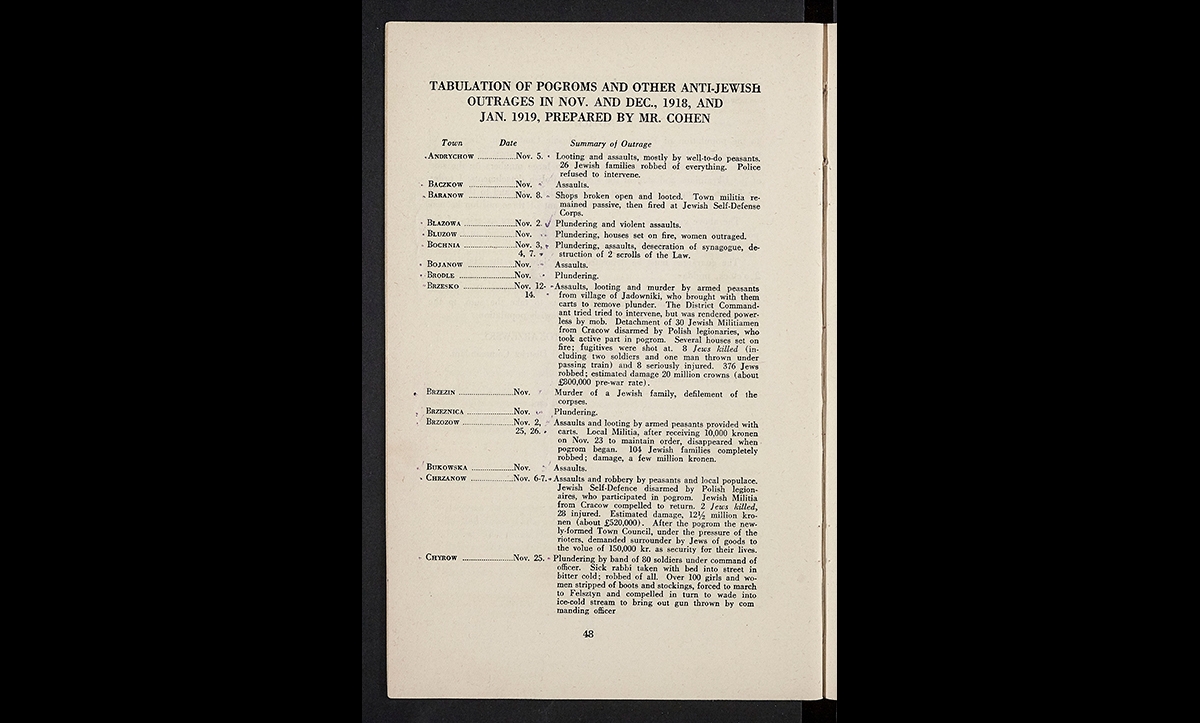
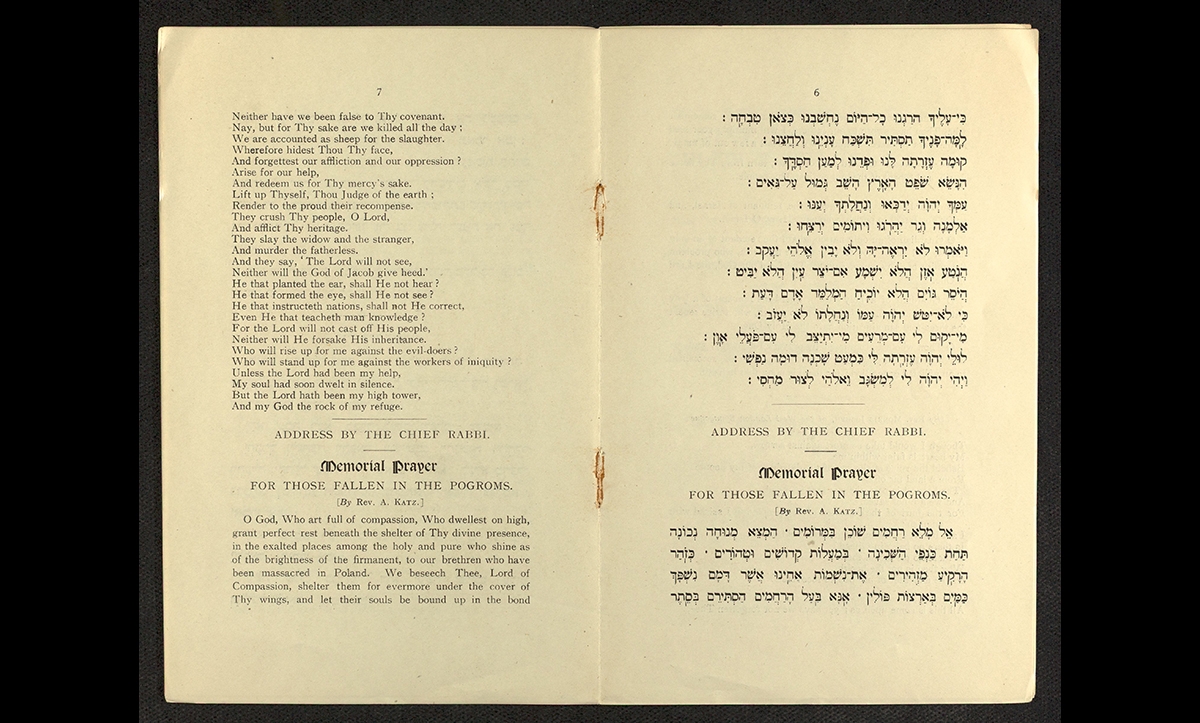
A pogrom is an outbreak of mass violence directed against a minority religious or ethnic group, most often referring to attacks against Jewish communities. The term has Russian origins and gained widespread usage during the outbreak of anti-Jewish violence in the Russian Empire in the 1880s. Anti-Jewish pogroms occurred in frequent waves in Eastern Europe in the nineteenth and twentieth centuries, specifically in the borderlands of the Austrian, German and Russian Empires.

Pogroms can be hard to define. Different events that have been referred to as pogroms vary massively in nature, causes, and scale, ranging from riots targeting Jewish property, to violent attacks that today could reasonably be called genocidal.

They most often broke out in borderlands regions with diverse ethnic communities. During times of socio-political upheaval, tensions between these communities heightened. Ethnic groups such as Russians, Ukrainians and Poles saw Jews as the cause of their problems due to deep-rooted antisemitism and instigated attacks on their local Jewish community. Once it began, violence could spread quickly through different villages, towns and cities. These pogroms were often met with passivity, and at times encouragement, by local authorities.

The first large wave of pogroms began in the southwest of the Russian Empire (modern-day Ukraine) from 1881-1884. They involved physical humiliation and the plunder of Jewish property but mostly stopped short of physical violence.

Pogroms in the early twentieth century were far more deadly. For example, in the 1903 Kishniev Pogrom, 49 Jews were killed, 700 houses burned down, and 600 shops looted within 48 hours.

In 1905-6, there were over 600 pogroms in the Pale of Settlement in what was then the western region of the Russian Empire, largely instigated by labour migrants looking for work. Over 3,000 Jews were murdered, and entire neighbourhoods were destroyed.

Pogrom activity escalated further during World War I (1914-1918) and the Russian Civil War (1919-21). In this period, different national and ethnic armies led brutal attacks of unprecedented scales against Jewish communities, characterised by mass killing and sexual violence. It is estimated over 50,000 Jews were murdered in pogroms during the Russian Civil War.

Pogroms eventually subsided in the areas of the new Soviet Union after 1921 but continued in other areas of Eastern Europe. For example, multiple small attacks occurred in Poland in the late 1930s.

The violence of this era of pogroms would ultimately be overshadowed by the Holocaust.



ADVANCED CONTENT

The 'Y' Word

This short film ‘The Y-Word’, produced for the Kick It Out campaign, looks at antisemitism in football today.


Continue to next topic
The development of nations

The development of nations

What happened in July